
Listening to what was shared, I had so many questions including:
- What topics did they study?
- What grade levels did they study?
- What teaching models did they study?
- What was each teaching model about?
- How were sites selected?
- How were sites assigned a teaching method?
- How well did each site implement their teaching method?
- How conclusive were the results?
I wanted answers to come directly from the actual report, and it took me a while to find it. Eventually I located it on the National Institute of Direct Instruction website as a scanned copy.
I’ve organized what I’ve found into two sections:
- Answering my questions using what I could find in the PFT final report
- Fact checking the podcast with what I could find in the PFT final report
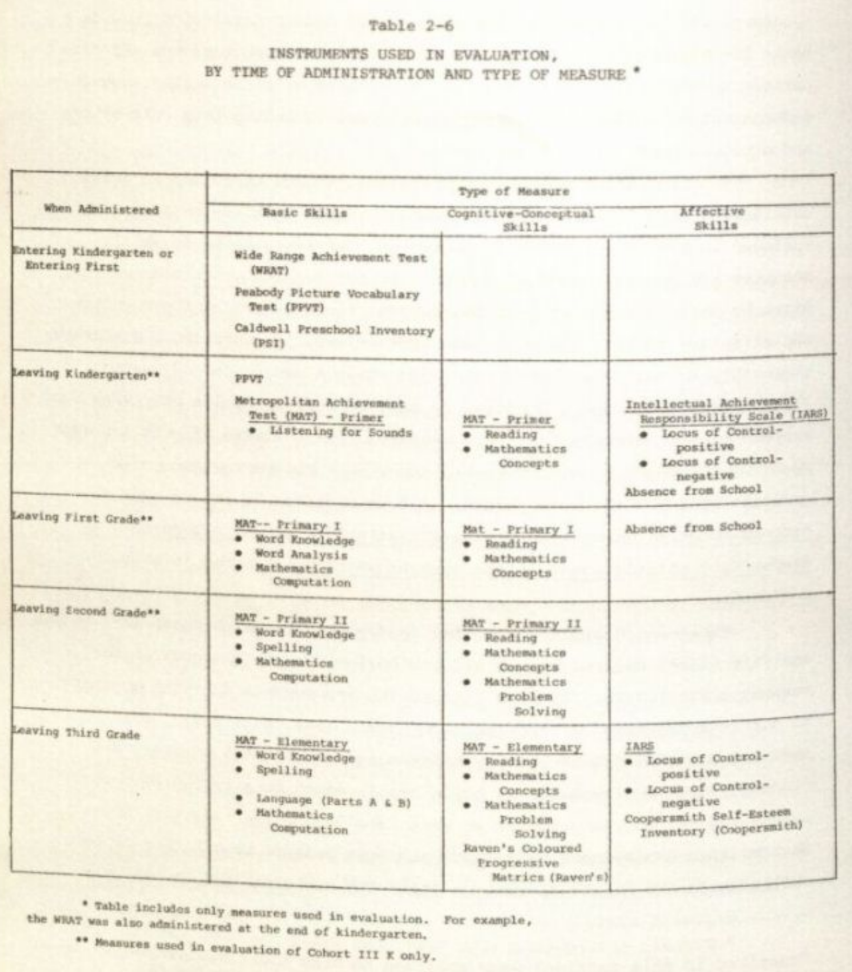
Here is the text for the specific topics which varied by grade level:
| When Administered | Type of Measure | ||
|---|---|---|---|
| Basic Skills | Cognitive-Conceptual Skills | Affective Skills | |
| Students entering kindergarten or entering first grade |
Wide Range Achievement Test (WRAT) Peabody Picture Vocabulary Test (PPVT) Caldwell Preschool Inventory (PSI) |
||
| Students leaving kindergarten |
|
|
|
| Students leaving first grade |
|
|
Absences from school |
| Students leaving second grade |
|
|
|
| Students leaving third grade |
|
|
|
Source:
Printed pg 36, PDF pg 61, Table 2-6
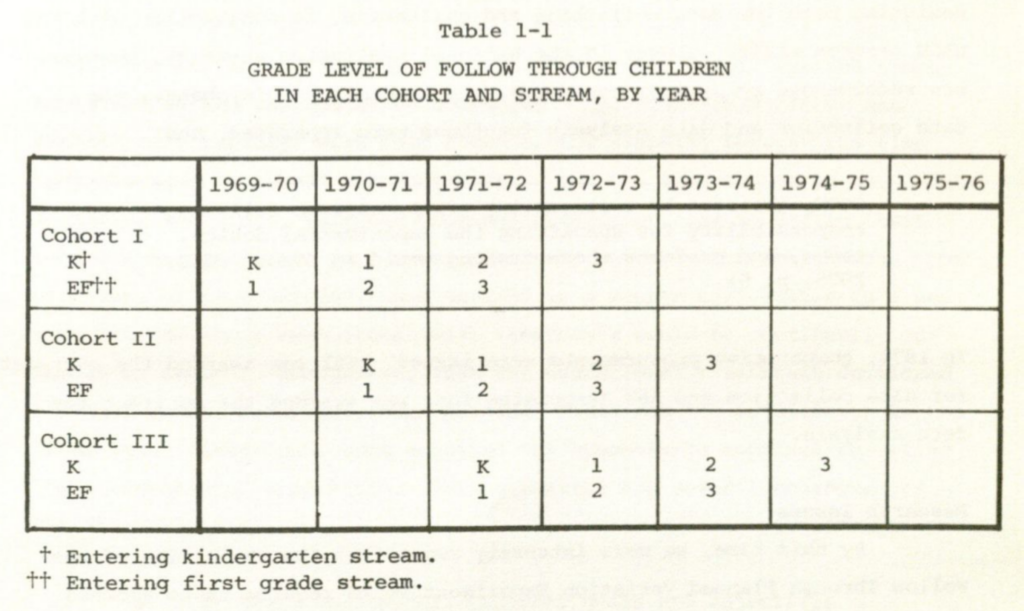
Sources:
Printed pg 7, PDF pg 32, Table 1-1 as well as lines 13 to 14
Printed pg 8, PDF pg 33, lines 1 to 5.
At one time Follow Through program embraced 22 sponsors working with 178 sites. These sponsors represented the spectrum of approaches to early childhood education existing in 1968-1971. This evaluation report includes evidence on the progress of children served by the 17 models listed in Table 2-1 (counting the five self-sponsored sites as a single model or group).
Below is Table 2-1. It’s hard to read, so I reproduced it in text.
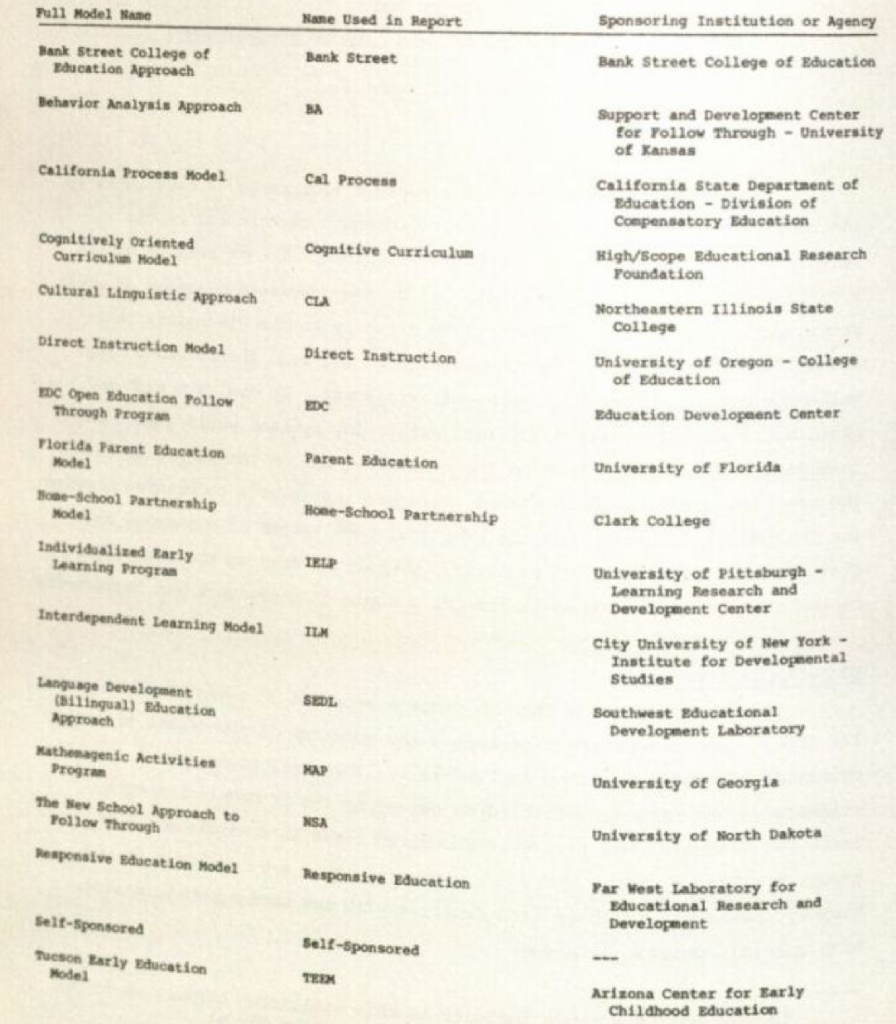
| Full Model Name | Name Used in Report | Sponsoring Institution or Agency |
|---|---|---|
| Bank Street College of Education Approach | Bank Street | Bank Street College of Education |
| Behavior Analysis Approach | BA | Support and Development Center for Follow Through – University of Kansas |
| California Process Model | Cal Process | California State Department of Education – Division of Compensatory Education |
| Cognitively Oriented Curriculum Model | Cognitive Curriculum | High/Scope Educational Research Foundation |
| Cultural Linguistic Approach | CLA | Northeastern Illinois State College |
| Direct Instruction Model | Direct Instruction | University of Oregon – College of Education |
| EDC Open Education Follow Through Program | EDC | Education Development Center |
| Florida Parent Education Model | Parent Education | University of Florida |
| Home-School Partnership Model | Home-School Partnership | Clark College |
| Individualized Early Learning Program | IELP | University of Pittsburgh – Learning Research and Development Center |
| Interdependent Learning Model | ILM | City University of New York – Institute for Developmental Studies |
| Language Development (Bilingual) Education Approach | SDEL | Southwest Educational Development Laboratory |
| Mathemagenic Activities Program | MAP | University of Georgia |
| The New School Approach to Follow Through | NSA | University of North Dakota |
| Responsive Education Model | Responsive Education | Far West Laboratory for Educational Research and Development |
| Self-Sponsored | Self-Sponsored | — |
| Tucson Early Education Model | TEEM | Arizona Center for Early Childhood Education |
Sources:
Printed pg 19, PDF pg 44, lines 16 to 18
Printed pg 20, PDF pg 45, Table 2-1
Bank Street College of Education Approach
The Bank Street approach is a rational, democratic life situation in the classroom. The child participates actively in his own learning and the adults support his autonomy while extending his world and sensitizing him to the meanings of his experiences. The teaching is diagnostic with individualized followup. There is constant restructuring of the learning environment to adapt it to the special needs and emerging interests of the children, particularly their need for a positive sense of themselves.
Source:
Printed pg 7, PDF pg 10, Lines 1 to 8
Behavior Analysis Approach
The behavior analysis model is based on the experimental analysis of behavior, which uses a token exchange system to provide precise, positive reinforcement of desired behavior. The tokens provide an immediate reward to the child for successfully completing a learning task. He can later exchange these tokens for an activity he particularly values, such as playing with blocks or listening to stories.
Source:
Printed pg 9, PDF pg 12, Lines 1 to 6
California Process Model
This is the only Follow Through approach for which a state agency is the sponsor. As the name implies, the model is dynamic and follows no single curriculum approach. It is in fact a cooperative effort of the state department of education and six California school districts. The approach is diagnostic-prescriptive; that is, the specific goals and objectives of each Follow Through community are determined by the Developmental Team in that community with the assistance of the sponsor. The local Developmental Teams include representatives from all elements of the Follow Through program including parents, teachers, aides, older students, representatives of the community, the sponsor, and funding agencies.
Source:
Printed pg 11, PDF pg 14, Lines 1 to 11
Cognitively Oriented Curriculum Model
The High/Scope Educational Research Foundation model represents a synthesis of research in preschool and early elementary education. The program recommends an “open framework” classroom that combines emphasis on active experience and involvement of the child; a systematic, consistent, and thoroughly planned approach to child development and instruction by the teacher; and continuous assessment of each child’s level of development so that appropriate materials and activities can be provided. This approach is based on the conviction that telling and showing do not teach, but that active experience with real objects does.
Source:
Printed pg 13, PDF pg 16, Lines 1 to 9
Cultural Linguistic Approach
In language elicitation episodes, the children are encouraged to express their thoughts, concepts, and ideas in their own language. These episodes are taped and analyzed by the teacher, and the information is used to develop initial reading materials and to plan future lessons. All subject matter, including math and science, is introduced to pupils in language episodes that take advantage of the child’s inherent oral capacity.
Source:
Printed pg 15, PDF pg 18, Lines 13 to 19
Direct Instruction Model
Using programmed reading, arithmetic, language, art, and music materials and behavior modification principles, the model employs strategies to teach concepts and skills required to master subsequent tasks oriented toward a growing level of competence. Emphasis is placed on learning the general case, i.e., developing intelligent behavior, rather than on rote behavior. Desired behaviors are systematically reinforced by praise and pleasurable activities, and unproductive or antisocial behavior is ignored.
Source:
Printed pg 47, PDF pg 50, Lines 7 to 13
EDC Open Education Follow Through Program
The child’s experience is one of the starting points for teaching in an open classroom; the teacher’s input is another. The role of the teacher is an active one. Teachers lead children to extend their own projects, through thoughtful responses and suggestions. The classroom is carefully supplied with materials that are likely to deepen children’s involvement.
Source:
Printed pg 19, PDF pg 22, Lines 24 to 28
Florida Parent Education Model
As the name of this model implies, its primary focus rests on educating parents to participate directly in the education of their children and motivating them to build a home environment that furthers better performance on the part of the child both in school and in life. Basic to the model is recognition of the fact that parents are a key factor in the emotional and intellectual growth of their children and that they are uniquely qualified to guide and participate in their children’s education.
Source:
Printed pg 21, PDF pg 24, Lines 1 to 7
Home-School Partnership Model
A parent aide program, an adult education program, and a cultural and extra-curricular program are the principal elements of this model. The model aims to change early childhood education by changing parent, teacher, administrator, and child attitudes toward their roles in the education process. It is believed this can be done by motivating the home and school to work as equal partners in creating an environment that supports and encourages learning.
Source:
Printed pg 25, PDF pg 28, Lines 1 to 7
Individualized Early Learning Program
A test for each objective in the sequence of teaching confirms that prerequisite skills have been acquired. Thus the curriculum specifies skills the student needs to enter the curriculum at any point and obviates wasting time on skills he already has. A special effort is made to help the child develop the self-management skills complementary to such a curriculum. An exploratory program under development provides opportunities for the child to apply and extend his skills and concepts in a relatively informal and open-ended environment.
Source:
Printed pg 27, PDF pg 30, Lines 16 to 23
Interdependent Learning Model
Games are a central feature of the ILM model, often being used in combination with certain aspects of programmed instruction to achieve instructional and social objectives. Since the focus is on “learning to learn,” curriculum content is not specific, although suggested games dealing with specific content areas, such as language, are being developed. In introducing new games the teacher typically follows a strategy of teaching from within; she demonstrates how to play by actually playing the game with a group, verbalizing what is being done and why and serving as a model rather than actually teaching; ultimately she transfers much of the control to the game rules, encouraging the children to direct their own learning.
Source:
Printed pg 29, PDF pg 32, Lines 17 to 26
Language Development (Bilingual) Education Approach
The theory applied by the model is that concepts first learned in the dominant language can easily be transferred later to a second language. Step-by-step sequenced procedures are followed in teaching language patterns, and both teaching techniques and materials are designed to develop a hierarchy of thinking processes, specific terminology, and symbols. Drills, games, and exercises are used to overcome individual linguistic problems.
Source:
Printed pg 31, PDF pg 34, Lines 9 to 15
Mathemagenic Activities Program
An activity-based curriculum is essential to this model since it postulates active manipulation and interaction with the environment as the basis for learning. Individual and group tasks are structured to allow each child to involve himself in them at physical and social as well as intellectual levels of his being. Concrete materials are presented in a manner that permits him to experiment and discover problem solutions in a variety of ways.
Source:
Printed pg 33, PDF pg 36, Lines 7 to 13
The New School Approach to Follow Through
The approach is not so concerned with instructional content as the processes by which content is taught and the conditions under which children learn. The goal of the approach is to create classrooms in which children continue to wonder and imagine; are open and honest and respectful of themselves, adults, and other children; are intensely involved and led by their natural curiosity to concern and commitment; initiate activities and take responsibility for their own learning; and are willing to face uncertainty and change with confidence. Classrooms responsive to these dicta are each likely to develop their own unique character.
Source:
Printed pg 35, PDF pg 38, Lines 8 to 17
Responsive Education Model
In the Responsive Model classroom the child is free to explore within a carefully controlled environment containing learning centers and a variety of games and activities. There is freedom to choose activities within already established limits. What he chooses to do is more likely to become important to him, to stimulate affective involvement, and to pose real problems. The child searches for solutions to problems in his own way, using a variety of resources, both physical and human. The teachers guide his discovery of solutions.
Source:
Printed pg 39, PDF pg 42, Lines 24 to 31
Self-Sponsored
In addition to sponsored projects, there are a few projects from the early group of pilots preceding the planned variation phase of Follow Through who elected to remain unsponsored (the only projects given this option). They are classified as self-sponsored or parent implemented and have instituted programs they themselves have developed.
Source:
Printed pg 3, PDF pg 7, Lines 31 to 35
Tucson Early Education Model
The model calls on teachers to individualize their teaching and emphasizes persistent adult-child interaction on a one-to-one basis. To meet the needs and learning rates of individual children, the model provides a great variety of behavioral options, including both self-selected and structured activities.
Source:
Printed pg 45, PDF pg 48, Lines 7 to 11
School districts were selected from those initially nominated by state, school, and OEO officials. The criteria used in selecting the districts indicate that the program administrators were less concerned with the effect of the selection process on the external validity of the results than they were with choosing districts with a high probability of success in the first year of the program.
Sources:
Printed pg 3-4, PDF pg 28 line 17 to pg 29 line 7
The process of matching the sponsor with the school districts began in late February, 1968, when 14 potential sponsors and “hundreds of representatives of school districts, Head Start Programs, Community Action Agencies, parent groups, and state agencies were brought together.” The sponsors at this meeting made presentations on their approaches while the community representatives and school officials listened, each seeking a sponsor who seemed compatible with local needs and attitudes. At the conclusion of this meeting, districts selected their sponsors. Some districts affiliated with their first choice; others, because of the need to distribute sponsors among sites, with their second or third choice. Other districts exercised their option not to affiliate but to become what is know[n] as “self-sponsored;” i.e., the local school district would take responsibility for developing its own model.
Sources:
Printed pg 3-4, PDF pg 28 line 17 to pg 29 line 7
Perhaps our clearest finding is that each model’s performance varies widely from site to site. An unknown proportion of this variation results from implementation problems, of which we have no analytically useful record.
I interpret this to mean that the same teaching model could have very different results at different sites, and the researchers couldn’t determine how much of those differences was due to how well the model was implemented.
We turned our primary attention from the study of model average effects to that of site effects, so as not to obscure the results of good implementations by averaging them with those of the bad ones. Most of the models were tried out in enough sites that one might reasonably expect at least one good implementation.
I interpret this to mean that the researchers chose to look at how each teaching model performed at individual sites rather than just looking at the average results across all sites. They believed that if a model was used at enough sites, at least one sites would probably implement it well. However, because they couldn’t determine which sites actually implemented the model well, they couldn’t know whether differences in results were caused by implementation or something else.
In a practical sense, we can be fairly confident that a model can produce at least as much progress as it showed in its best site. On the other side of the coin, the same model can clearly do at least as badly as it did in its worst site.
I interpret this to mean that the researchers believed the best and worst results for each teaching model provided examples of how well or poorly the model might perform. However, because they couldn’t determine how well those sites implemented the model, they couldn’t predict whether other sites would have similar results.
Lacking information about implementation (what if a model did best in a site that had not implemented it well?), we can only give the models the benefit of the doubt in this matter.
I interpret this to mean that the researchers couldn’t determine whether sites with strong results had actually implemented the teaching model well. Similarly, they couldn’t determine whether sites with poor results had implemented it poorly. Accordingly, they couldn’t tell how much of the differences in results were due to implementation versus other factors that varied between sites.
Source:
Printed pg 166-167, PDF pg 191 line 19 to pg 192 line 2
The results of our analyses imply a number of conclusions about the performance of Follow Through children. Since Project Follow Through is a quasi-experiment, these results are subject to alternative interpretations, some deriving from our analytic methods and others from broader insights on the complicated reality that a wide-ranging yet incomplete set of measures cannot help oversimplifying.
Questions that could legitimately be raised include:
1. Might differential attrition of pupils from FT and NFT groups over the four years of treatment bias the evaluation results?
2. Are we using the best possible model to assess the effectiveness of Follow Through? How adequate is our covariate set, and are the results we find dependent upon the particular covariates we selected?
3. Can we meet the assumptions our analyses make about how the data are distributed?
4. How comparable are the results from different analyses?
5. What relationships exist among effects from different analyses?
With respect to each question above, we present results of some auxiliary analyses performed on Cohort III-K that should enhance the plausibility of our analytic procedures. These results are neither complete nor exhaustive. In this quasi-experimental context, we cannot hope to lay all doubts and objections to rest, but we have expended considerable effort to check our conclusions, with the effect of reinforcing our confidence in the results.
Source:
Printed pg 81-82, PDF pg 106 line 16 to pg 107 line 7
It was a tense dynamic sometimes — these young people coming in, telling veteran teachers to do things differently.
Andrist: I had a couple of teachers who just were really negative.
Allen: I was hated a lot.
This is Adrienne Allen again.
Allen: Because I was a policeman. I went in and made sure that they were following the script.
There were teachers who did not like those Direct Instruction scripts. They wanted to do their own thing.
Allen: Some of them would lock the door, and they would pull down the shade so that I couldn’t see in the classroom or go into the classroom.
She had supportive principals who would help her out. But some principals were not supportive. And there were other obstacles. This is Jerry Silbert again.
Silbert: I remember one site — we did a training for a week or two. And then the teachers got transferred. So, school starts and we’re missing half the teachers who were trained.
Other programs being tested as part of Project Follow Through were facing similar challenges.
Larry Schweinhart: I remember in one classroom….
Larry Schweinhart worked on a program called High/Scope.
Schweinhart: The teacher was doing business as usual and she looked up at me when I came in and she said, “Do you want me to do the High/Scope now?”
She wasn’t doing the program. It’s not clear why. But it’s not that surprising that some teachers were reluctant. These were new, untested ways of teaching.
It was up to the program developers to get teachers on board. To figure out how to make the educational ideas they believed in work in the real world.
Source:
pg 4 lines 2 to 22
Report
There has been no adequate assessment of whether the sponsors’ evolving programs were implemented. We have, therefore, had no way to address the research issue, “Do differences of implementation of an educational strategy have any relationship to differences in impact?”
Source:
Printed pg 10, PDF pg 35 lines 7 to 12
Measuring all those things was going to be difficult. How do you know if a program has succeeded in helping a child become independent or creative? And even if you can reliably measure those things, how are you going to compare programs to each other if they have such different goals?
Source:
pg 5 lines 6 to 8
Report
To evaluate each model’s performance on every measure of interest to any sponsor would impose unreasonable costs and burdens on the evaluation and on the people involved; the measures actually administered therefore represent a compromise between the demands of diversity and the practical constraints of resources and available instruments. Unfortunately, we have no data on the adequacy or costs of this compromise so it remains a topic of conjecture and controversy.
Source:
Printed pg 19, PDF pg 44 lines 10 to 16
Podcast
They thought it was a messy study that could have been set up better. The measures weren’t perfect. And they concluded some of the government’s statistical analysis was flawed.
Source:
pg 5 lines 6 to 8
Critique
“They thought it was a messy study that could have been set up better.”
The whole classification scheme was vague and ill-defined. No check on the validity of the classification is reported, even though it shaped the findings.
“The measures weren’t perfect”
Not only were outcomes such as improvements in personality and character not measured, but even such straightforward skills as the ability to read aloud, to write a story, or to translate an ordinary problem into numbers went unassessed. Both explicit and implicit goals of primary education in almost all schools are much broader than the measures used, and it would be reckless to suppose that the results of the testing indicate the attainment of these broader goals.
“And they concluded some of the government’s statistical analysis was flawed.”
Abt Associates analyzed test scores so that the number of students in the models influenced how good the models appeared to be. When this irrelevant influence is removed from the analyses, a different order of effectiveness is found. The Abt Associates’ ordering of models by effect is thus suspect.
Source:
Printed pg 463, PDF pg 2
I appreciate you doing all his work to fact check. Often in education people, higher Ed, companies, etc. claim to have the “evidence” yet when you dig in, the research design measured something different. For example, the notion of “Direct Instruction” is never consistently defined and there is no agreement in the school Psych world or math education world of what hat exactly is if each classroom is approaching it the same as well as varying mental models of what it is. Personally I think Sold A Story, sold us a story.
Thank you, Anne. I am hoping this information helps everyone have a more complete picture of Project Follow Through.
For whatever reason, I have only recently realised the importance of the School of Education being under the umbrella of Social Sciences. Does that mean it is somewhere between Sociology and Psychology? Anyway, it is not an exact science governed by laws like engineering, physics or chemistry. It is is also not business – input gadget at a cost price, determine a sale price and calculate the profit. At best we can have guidelines or frameworks but working with people means it is not as simple as crank the handle of whatever educational philosophy you ascribe to produce the same result every time. The sooner governments, academics and business people realise teachers ands students are not KPIs, the better.